
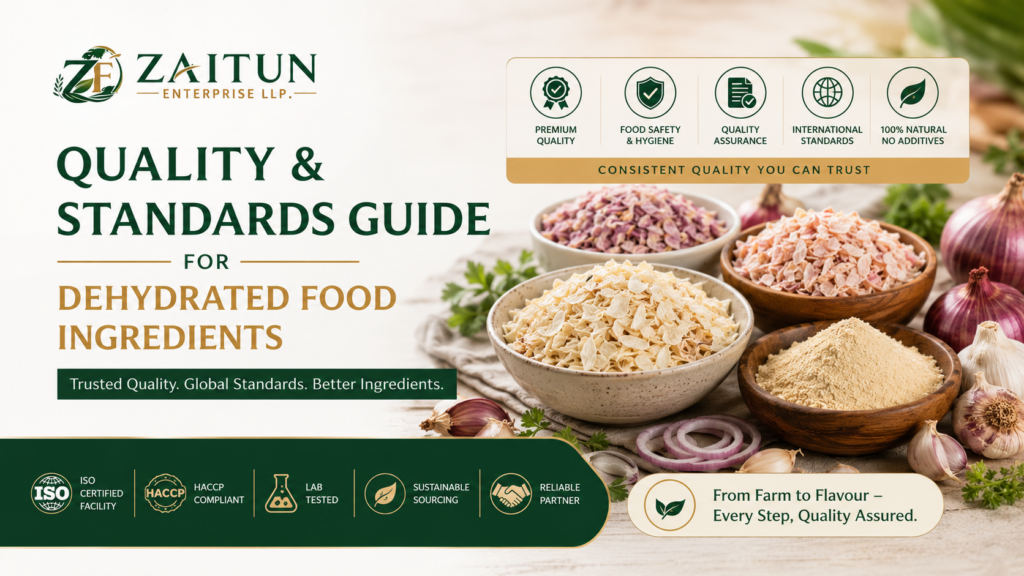
In global food manufacturing, your final product safety and brand reputation rest entirely on the purity of your raw ingredient inputs. Dehydrated spices, roots, and dried alliums act as concentrated flavor vehicles across snack food dustings, canned soups, prepared sauces, meat processing, and frozen meal lines. Because your factory utilizes these dry ingredients in concentrated quantities, a single quality defect in an incoming raw shipment can compromise thousands of consumer-ready packages on store shelves.
When you establish strict analytical testing protocols, sanitary processing mandates, and global compliance certifications across your procurement line, you protect your business from costly product recalls and factory shutdowns.
Why Quality Dehydrated Food Ingredients Matter in Manufacturing
When you specify verified Quality Dehydrated Food Ingredients for your processing lines, you secure predictable behavior during high-speed automated blending, baking, extrusion, and liquid compounding. When raw dehydrated inputs carry inconsistent moisture levels or variable particle sizes, automated micro-dosing machinery misfires, causing uneven product distribution, weight discrepancies, and expensive batch rejections.
When your factory procurement team sources certified Quality Dehydrated Food Ingredients, you eliminate batch-to-batch variation. High-purity convective processing protects delicate essential oils, stabilizes natural color hues, and guarantees that your operational recipes taste identical across every production facility you run.
Key Processing Standards for Dry Vegetables and Spices
Maintaining clean processing demands strict physical separation between raw agricultural receiving bays and post-dehydration packaging cleanrooms.
Core Processing Benchmarks
To keep your factory compliant with international food safety codes, your processing partner must satisfy these four core operational benchmarks:
- Hygienically Processed Food Ingredients: Dehydration plants must enforce positive air pressure cleanrooms, automated equipment sanitation, and strict employee personal hygiene to eliminate cross-contamination risks.
- Additive Free Dehydrated Products: Clean-label consumer demands require raw ingredients that contain zero chemical preservatives, no artificial food dyes, and no sodium-based anti-caking agents.
- Consistent Quality Food Ingredients: Standardizing convective air drying temperatures preserves delicate natural plant sugars without scorching, ensuring stable rehydration ratios across every batch.
- Food Quality Standards: Processing facilities must hold active certifications under recognized global safety management frameworks, including FSSAI, ISO 22000, and HACCP systems.
Product-Specific Quality Verification Protocols
Different dehydrated alliums require specialized laboratory screens prior to commercial dispatch. You must verify that your supplier conducts targeted analytical tests for each specific ingredient category.
Garlic and Ginger Quality Criteria
Garlic and ginger products demand precise particle size verification and active volatile compound testing:
- Garlic Powder: Laboratory screening must verify uniform mesh distribution, active allicin compound retention, and complete absence of outer protective skins or root scales. Sourcing from a reliable supplier of Garlic Powder guarantees high allicin potency.
- Dehydrated Ginger Powder: Tested for crude fiber percentage, active gingerol content, and clean spicy warmth without bitter undertones. Working alongside a trusted supplier of Ginger Powder protects your bakery and beverage formulations.
Onion Product Quality Criteria
Onion inputs are categorized by physical cut and color variety, with each type requiring individual quality release testing:
- Premium Dehydrated Onion Products: Tested for pyruvic acid concentration (pungency index), residual moisture limits, and total water absorption capacity upon rehydration.
- Premium Dehydrated Garlic Products: Screened for uniform light cream color, instant solubility in liquid bases, and zero heat scorching.
- Premium Dehydrated Ginger Products: Checked for fine powder particle size, low total ash percentages, and sharp characteristic aroma.
- Dehydrated Pink Onion Products: Monitored for natural pink hue retention without color fading during ambient storage. Procuring via a specialist in Pink Onion Flakes or a manufacturer of Pink Onion Powder keeps your seasoning mixes vibrant.
- Dehydrated Red Onion Products: Analyzed for deep reddish-purple anthocyanin color intensity and robust savory pungency. Partnering with a supplier of Red Onion Flakes or a certified manufacturer of Red Onion Powder prevents batch discoloration.
- Dehydrated White Onion Products: Screened for complete absence of dark specks, burnt skin fragments, or extraneous agricultural material. Sourcing through a supplier of White Onion Flakes or a specialized manufacturer of White Onion Powder guarantees clean visual clarity in pale sauces.
Essential Steps in Food Ingredient Quality Control
Robust Food Ingredient Quality Control operations enforce multi-stage testing protocols throughout the dehydration timeline:
- Incoming Agricultural Inspection: Raw onions, garlic, and ginger arriving from farms undergo visual checks for rot, dirt loading, and pesticide residue screening before entering processing bays.
- In-Process Moisture Monitoring: During drying, automated hot-air convective systems continuously track heat and humidity levels to prevent surface hardening.
- Optical & Magnetic Separation: Dried flakes pass through multi-channel optical color sorters and high-gauss rare-earth magnets to strip away discolored pieces and trace metallic particles.
- Final Laboratory Release: Every production lot is tested for total plate count (TPC), yeast, mold, Salmonella, and E. coli before issuing a formal Certificate of Analysis (COA).
Applying these stringent quality controls ensures your production lines run without interruption while delivering safe food products to global consumer markets.
Sourcing Verified Quality Ingredients from Gujarat, India
When you source dehydrated ingredients internationally, geographic region plays a massive role in baseline crop quality. The western region of Gujarat, India, serves as an agricultural leader for high-solids onion and garlic cultivation.
Working with a direct Dehydrated Onion Garlic Ginger Manufacturer operating near these growing belts provides distinct advantages. Fresh crops move from farm gates to processing air-dryers within hours, preserving natural essential oils and vibrant colors. As an established manufacturer in Gujarat, Zaitun Enterprise implements rigid lab testing protocols across every batch to ensure international food safety compliance.
When your procurement team partners with an integrated Dehydrated Food Ingredients Supplier, you gain full traceability from farm soil to finished bulk packaging. To review our complete lab specifications or request sample batches for testing, feel free toreach out to us directly.
Frequently Asked Questions (FAQ)
What is the maximum allowable moisture content for bulk dehydrated ingredients?
Global food safety standards mandate a maximum moisture content of 6.0% for dehydrated onion, garlic, and ginger products. Keeping moisture strictly below this threshold prevents clumping, enzymatic degradation, and bacterial growth during long storage periods.
Why is optical color sorting critical during dehydrated vegetable processing?
Optical color sorters use high-speed optical cameras to scan every passing flake, instantly blowing away discolored pieces, burnt particles, and foreign organic matter using high-pressure air jets. This guarantees complete visual uniformity across your bulk shipment.
What is the difference between pyruvic acid testing and moisture testing in onions?
Moisture testing measures the percentage of remaining water in the dried product, whereas pyruvic acid testing measures flavor pungency. Higher pyruvic acid levels indicate a stronger, sharper onion taste when your recipe rehydrates the product.