
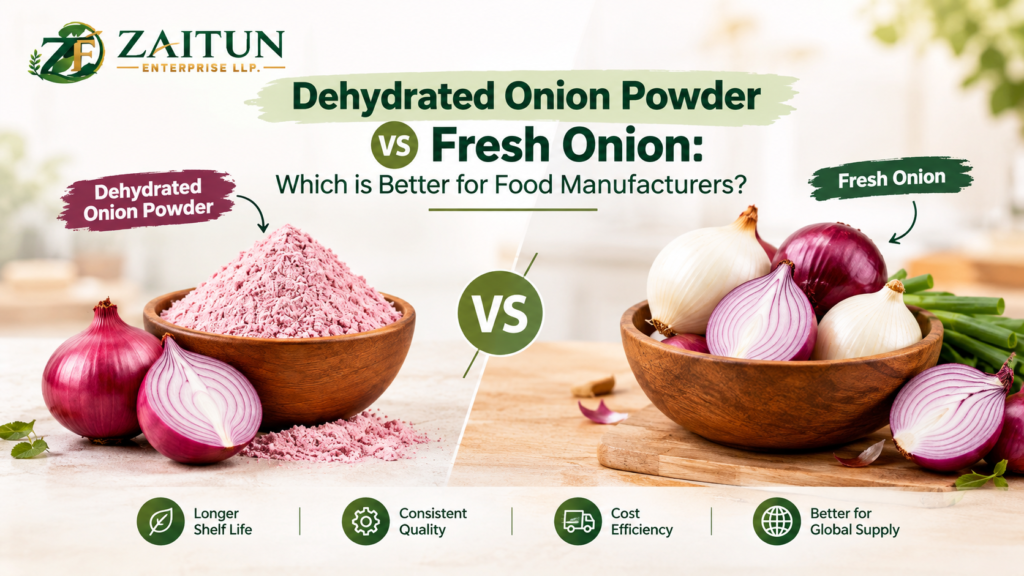
Food manufacturers across India and global export markets face a recurring decision at the ingredient desk: should the next batch run on fresh onions or on dehydrated onion powder? The answer rarely stays the same across product categories, order volumes, or shipping routes. What works for a small sauce bottler in Pune can be entirely wrong for a frozen-meal exporter shipping out of Mundra port.
This guide puts both options side by side on the metrics that actually move production cost, consistency, and compliance. If you run a QSR chain, a seasoning blend plant, a ready-to-eat kitchen, or an export-grade snack unit, the comparison below will help you make a sharper call before the next purchase order goes out.
Why Food Manufacturers Are Rethinking Fresh Onions
For decades, fresh bulbs were the default. They were cheap, locally grown, and familiar to kitchen staff. The last few years have shifted that equation. Fresh onion prices in Indian mandis now swing 200 to 400 percent within a single harvest cycle, driven by rainfall, storage losses, and export policy changes. When onion makes up 30 to 40 percent of your recipe cost, that volatility hits margins hard.
Add the hidden costs: peeling waste (up to 15 percent), labour hours, water usage, cold storage, and shrinkage during transit. Many production heads are now asking whether a dehydrated vegetable powder solution would stabilise both their budget and their batch quality. The honest answer, in most commercial-scale scenarios, is yes.
What Dehydrated Onion Powder Actually Is
Onion dehydration is a controlled process where freshly washed, peeled, and sliced onions pass through hot-air drying tunnels until moisture levels drop below 6 percent. The dried pieces are then milled into powder or kept as flakes, granules, or chopped forms depending on end use.
The onion by products category also includes dehydrated onion flakes, kibbled onions, and spray-dried onion juice powders, each serving a specific texture or dispersion need. A quality Dehydrated Onion Manufacturer typically runs several SKUs across pink, red, and white varieties to match regional flavour preferences and colour requirements. Some facilities also function as a Spray dried fruit & vegetable powders manufacturer, giving buyers access to both dry-air and spray-dried outputs under one roof.
Common Commercial Forms
Food processors buy onion dehydrated in multiple grades. Flake sizes range from 3 to 10 mm for visible garnish applications. Granules in the 0.5 to 1 mm range work for dry seasonings. Fine powder below 100 mesh suits sauces, soup mixes, and extruded snacks where no visible particle is acceptable.
For buyers who want colour differentiation, white onion powder gives a mild, sweet profile suited to cream sauces and mayonnaise bases, while red onion powder brings a sharper, pungent note preferred in meat marinades and chutney blends.
The Real Comparison: What Matters on the Production Floor
Shelf Life and Storage
Fresh onions last 2 to 4 months under cold storage before sprouting, softening, or developing rot. In humid Indian climates, that window shrinks further. Dehydrated products hold 18 to 24 months in sealed packaging at ambient temperature, with no refrigeration cost and no sprouting risk.
For an export-oriented facility, this difference is decisive. A container of fresh onions bound for the Middle East can lose 8 to 12 percent to spoilage, while the same volume of dehydrated foods arrives at full weight and full value.
Cost Economics (The Yield Factor)
Here is where most calculations go wrong. One kilogram of dehydrated onion powder is equivalent to roughly 8 to 10 kilograms of fresh onion in flavour impact. When you compare per-kg prices directly, dehydrated looks expensive. When you compare on usable yield after peeling waste and moisture loss, the dehydrated product often costs 15 to 25 percent less per finished batch.
Factor in reduced labour (no peeling, no chopping, no washing), lower water bills, and zero cold-chain requirements, and dry vegetable powder usually wins the full-cost comparison across most commercial scenarios.
Flavour Consistency
Fresh onions vary batch to batch. Monsoon-harvested bulbs taste different from summer stock. Dehydrated vegetables manufacturers running laboratory-controlled drying can deliver near-identical flavour profiles across every lot. For brands that depend on taste standardisation (packaged snack brands, instant soup makers, QSR chains), this consistency is worth more than the raw material savings.
Reputable onion powder manufacturers also publish specification sheets covering pungency levels, pyruvate content, colour values, and bulk density, giving the R&D team real control over formulation.
Labour, Space, and Processing Speed
Fresh onion processing demands manpower, floor space, dedicated washing bays, and effluent handling. A mid-size unit using 500 kg of fresh onion daily often employs 6 to 10 workers just for prep. Switching to Dehydrated vegetables bulk packs can free up that labour for value-adding work and release 30 to 40 percent of your prep floor space.
Food Safety and Microbial Load
Fresh produce carries soil microbes, pesticide residues, and the risk of E. coli or Salmonella contamination. Reputable dehydrated food products manufacturers apply steam sterilisation and ETO-free treatments to bring total plate counts well below 10,000 CFU/g, with yeast and mould under 100 CFU/g. For HACCP-certified kitchens and export-grade units, that validation paperwork is often non-negotiable, and this is where Export Quality Dehydrated Food Products pay for themselves on a single rejected shipment avoided.
Which Industries Gain the Most?
Not every product line benefits equally. Here is where dehydrated vegetable powder tends to outperform fresh:
- Snack seasonings and dry mixes: Zero moisture is mandatory. Dehydrated is the only workable option.
- Instant noodles and soup bases: Rehydration in the end bowl needs quick-dispersing powder.
- Spice blends and masala manufacturing: Dry garlic powder, onion powder, and Dehydrated green chilli powder all go into the same blender; adding fresh ingredients would ruin shelf stability.
- Ready-to-eat gravies and retort pouches: Consistent viscosity and colour depend on standardised dry inputs.
- Export-grade frozen foods: Weight-based freight makes dehydrated foods far cheaper to ship.
- Bakery seasonings and cheese toppings: Fresh onion moisture would spoil the base.
A capable Food ingredients manufacturer India businesses supplying these segments usually keep multiple onion grades in stock, along with references for a Dehydrated garlic powder manufacturer, pink onion flakes, and specialty blends.
When Fresh Onions Still Win
To be fair, fresh onions remain the right choice in a few cases: artisan restaurants serving hand-chopped tadka, pickle makers who want fermentation-active enzymes, and local street-food operations with daily turnover and short supply chains. The question is scale. Once your daily usage crosses 50 to 100 kg, the operational drag of fresh produce rarely justifies the perceived flavour edge.
If flavour depth is the concern, understanding how manufacturers retain flavor & aroma during the drying stage is worth reading before dismissing the dehydrated route.
Picking the Right Supplier Matters More Than Picking the Format
Switching from fresh to dehydrated solves half the problem. The other half is sourcing from a Dehydrated vegetables manufacturer who respects specification tolerances every single lot. A good supplier should offer:
- Documented drying parameters (inlet temperature, residence time, final moisture).
- Varietal transparency (which cultivar, which region, which harvest season).
- Microbiological COAs per batch with third-party lab backing.
- FSSAI, FSSC 22000, HALAL, and KOSHER certifications depending on your export destinations.
- Flexible pack sizes from 25 kg kraft bags to 1-ton jumbo bags for different production scales.
- Steam sterilisation capability for microbiologically sensitive buyers.
A credible Dehydrated onion supplier will also stock complementary SKUs: dehydrated onion flakes, pink onion powder, fried onion birasta, and spray-dried fruit and vegetable concentrates. Centralising procurement with one partner cuts your purchase order load and tightens quality control across categories.
For B2B buyers moving larger volumes, Bulk Dehydrated Spices Supplier Worldwide credentials matter. Check whether the vendor has shipped to your destination country before. Documentation varies between the EU, GCC, USA, and ASEAN markets, and a seasoned Dehydrated food products exporter will already have the templates ready.
Beyond Onion: The Full Dehydrated Vegetable Range
Most food plants that switch to dehydrated onion end up expanding into other dried inputs within 6 to 12 months. The same logistics advantages apply to a Dehydrated Garlic Manufacturer range, dehydrated carrot flakes, beetroot powder, potato granules, and spinach powder.
If your product line uses multiple vegetables, consolidating with one Dehydrated Vegetables & Food Products Manufacturer simplifies cold chain, documentation, and credit terms. Many Indian suppliers also carry Commercial spray dried powder manufacturer capabilities for tomato, lemon, tamarind, pineapple, and cheese powders, letting you source wet-dried fruit solids and dehydrated vegetable powder suppliers under one invoice.
Buyers requesting Dehydrated white and red onion flakes export documentation should ask for IEC codes, phytosanitary templates, and port-of-entry clearance records up front. This is where a seasoned Dehydrated Foods & Spices Exporter saves weeks of back-and-forth, and where working with a well-established Dehydrated Onion Manufacturer with multi-country shipping history becomes a real competitive edge.
For a deeper breakdown of what separates reliable vendors from the rest, this onion powder sourcing guide covers audit checklists, lab testing parameters, and contract templates.
The Honest Verdict
For food manufacturers running at commercial scale, dehydrated onion powder outperforms fresh onion on cost per usable unit, consistency, shelf life, logistics, and compliance. Fresh onion keeps its edge only in artisan, low-volume, or taste-sensitive niche segments.
The real win is in picking the right production partner. A proven Dehydrated vegetable powder & flakes supplier gives you not just a product but a predictable input: same granulation, same colour, same moisture, batch after batch. That predictability is what unlocks tighter margins and smoother audits. Many dehydrated vegetable powder manufacturers now also act as a one-stop B2B dehydrated food products exporter, bundling onion, garlic, chilli, and specialty blends on a single container.
Buyers sourcing organic dehydrated foods should separately verify organic certifications (NPOP, NOP, EU Organic), since not every supplier carries them. Also ask about Fried Onion Birasta Supplier credentials if your product line extends into topped snacks, biryani mixes, or packaged garnishes. A Bulk fried onion birista supplier with QSR experience will understand your frying consistency and oil absorption requirements better than a generic vendor. For companies auditing a new Dehydrated Onion Manufacturer, a plant visit still beats any paperwork review.
Before placing your first trial order, review our quality standards and request a 1 kg sample across the grades you need. A short trial run on your actual recipe will tell you more than any spec sheet. Any dehydrated product that cannot hold its specification through two consecutive lots is a signal to walk away.
Frequently Asked Questions
Q1. How much dehydrated onion powder equals 1 kg of fresh onion?
Roughly 100 to 125 grams of dehydrated onion powder gives the same flavour impact as 1 kilogram of fresh peeled onion, depending on moisture content, mesh size, and the cultivar used.
Q2. Does dehydrated onion powder lose nutritional value?
Properly dried onion retains 85 to 90 percent of its original flavonoids, sulphur compounds, and dietary fibre. Vitamin C degrades to some extent, but onion is not a primary vitamin C source in most diets anyway.
Q3. Can dehydrated onion powder replace fresh onion in all recipes?
Most cooked applications work well. Rehydrate the powder in warm water for 10 minutes before adding to raw salads or garnishes. For deep-fried applications, dehydrated onion flakes are a better match than fine powder.
Q4. What is the typical shelf life after opening a bulk pack?
Sealed, 18 to 24 months. Once opened, store in airtight containers away from humidity and direct sunlight to retain 6 to 9 months of usable life.
Q5. Is dehydrated onion powder suitable for organic-certified products?
Yes, provided the supplier has valid NPOP, NOP, or EU Organic certification. Always ask for the scope certificate matching your export destination before confirming the order.
Q6. What is the minimum order quantity for bulk buyers?
MOQ varies by supplier and grade. Most B2B exporters accept trial orders from 100 kg, with regular supply contracts beginning at 500 kg per month. Established onion powder suppliers often offer tiered pricing above 2 tons.
Q7. Which onion powder grade suits snack seasoning best?
A fine-mesh (200 mesh) blend of white and pink onion powder works best for free-flowing snack coatings, giving even colour and quick dispersion on fried or baked bases.
Ready to Make the Switch?
If your production floor is still running on fresh onions, a trial batch with dehydrated onion powder could change your cost sheet within one quarter. For specification sheets, pricing per grade, and sample dispatch, contact us for bulk inquiry and the sourcing team at Zaitun Enterprise will respond with the right fit for your production profile.