
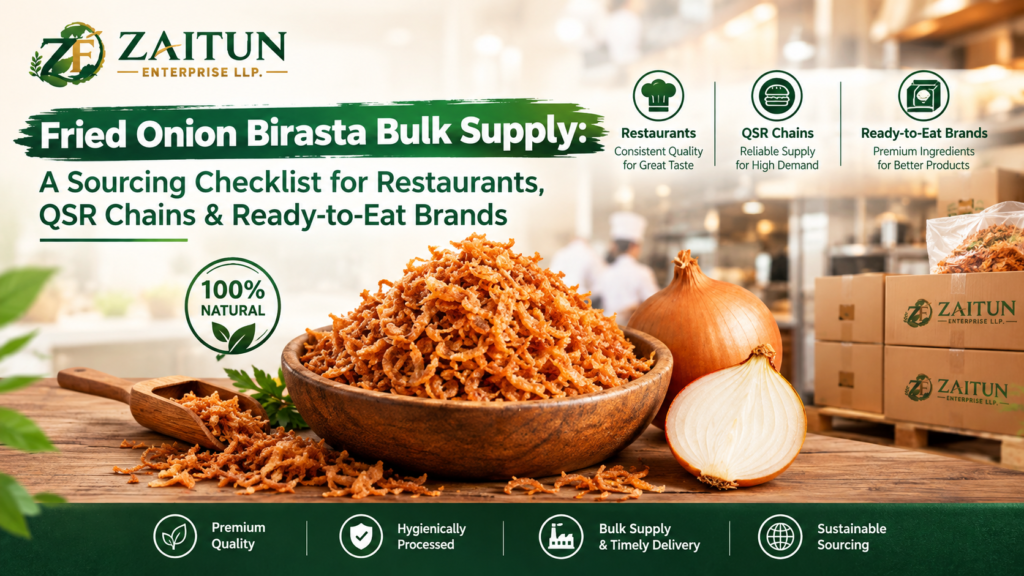
In a busy biryani kitchen in Hyderabad, a QSR burger line in Bengaluru, or a ready-to-eat gravy plant in Pune, fried onion birasta is one of those small ingredients that quietly decides whether the final dish looks right and tastes right. Get the colour wrong, the oil content too high, or the crunch missing, and the complaint tickets pile up fast. Get it right across every batch, and the kitchen stops thinking about it entirely.
The problem is that bulk birasta looks deceptively simple. Most buyers compare suppliers only on per-kilogram price and end up switching vendors every six months chasing stability. This guide is written for procurement managers, chef-partners, and brand owners who want to make the right call once, lock in a reliable supply chain, and stop losing operations time to inconsistent raw materials.
What Birasta Is and Why QSR Brands Rely On It
Birasta (also spelled birista) is thinly sliced onion, deep-fried in refined oil until crisp and golden-brown, then drained and packed. It is the finishing crown on biryanis, the texture layer in burger patties, the mandatory garnish on dal makhani in restaurant chains, and a staple in ready-to-eat gravy pouches sold in retail. In the north Indian wedding catering circuit alone, consumption runs into hundreds of tons every peak season.
For QSR and HORECA buyers, in-house frying is impractical at scale. Oil management, aroma control, hood ventilation, labour time, consistency across outlets, and food safety all become operational drags. A reliable Fried Onion Birasta Supplier solves these in a single purchase order: ready-to-use product, consistent crisp texture, same colour from one bag to the next, and shelf life measured in months rather than days.
Understanding how birasta fits alongside other onion inputs, including dehydrated flakes and powders, is covered in this guide on commercial uses of onion, garlic & ginger across food service formats.
The 7-Point Birasta Sourcing Checklist
Use this as a one-page filter before you accept the first sample from any new vendor. If the supplier cannot answer six out of seven cleanly, keep moving.
1. Raw Onion Variety and Origin
The starting onion determines everything that follows. Pink Nashik and Mahuva whites are the two most common raw inputs for commercial birasta in India. Pink gives a sweeter, caramel-forward profile; white delivers a cleaner, sharper fry. Red is used less often because of higher sugar content that can over-caramelise. A credible supplier should name the variety and region, not just say onion.
2. Oil Type and Fry Standards
Ask which oil is used (refined palmolein, sunflower, rice bran, or cottonseed), whether it is single-use or filtered-and-reused, and what the free fatty acid (FFA) limit is at point of fry. Reputable Bulk fried onion birista supplier operations run FFA below 1 percent and change oil batches on a measured schedule, not when the colour looks off.
3. Oil Content in Finished Product
Finished birasta typically contains 28 to 38 percent residual oil by weight. Below 25 percent, the product tastes dry and loses crunch quickly. Above 40 percent, it goes rancid within weeks and clumps in the pack. Any Fried Onion Birasta Supplier should publish this number on the COA.
4. Colour and Crispness Specification
Colour is measured by Lovibond or Hunter Lab* values. For most Indian QSR applications, a golden-brown Lab* around L 40, a +12 to +18, b +25 to +30 is the sweet spot. Crispness should hold for at least 60 days post-pack under normal ambient storage.
5. Microbiological Safety
For food service and ready-to-eat use, total plate count under 10,000 CFU/g, yeast and mould under 100 CFU/g, E. coli absent, and Salmonella absent in 25 g are the baseline numbers. Request a third-party lab report, not just the vendor’s in-house COA.
6. Shelf Life Claim
Sealed in laminated packaging with nitrogen flush, 6 to 9 months is realistic for standard birasta. Vacuum-packed, 9 to 12 months. Any claim beyond 12 months at ambient temperature needs stability data to back it.
7. Pack Sizes and Consignment Flexibility
Restaurants typically need 1 kg or 5 kg pouches, QSR commissaries prefer 10 to 20 kg cartons, and RTE plants work with 25 kg sacks or FIBC-style bulk packs. A vendor who stocks all three formats under one SKU family saves procurement from juggling multiple purchase orders.
Grades and Formats That Match Different End Uses
Not every kitchen needs the same grade of birasta. Matching the format to the application avoids waste and keeps the final dish on-spec.
- Fine shred (0.8 to 1.2 mm): Best for biryani finishing, dum pukht garnishes, and dal tempering. Rehydrates slightly in steam without going soft.
- Medium shred (1.5 to 2 mm): Standard for QSR burger patties, kebab stuffings, and samosa fillings. Holds crunch after moisture contact.
- Coarse shred (2.5 to 3.5 mm): For salads, sandwich toppings, and visible garnish on buffet-style dishes.
- Birasta flakes with low oil: For RTE pouches where oil migration into the gravy is undesirable.
For kitchens that also work with dehydrated onion flakes as a parallel SKU, white onion flakes are commonly used for tempering and dry seasoning blends, offering a milder, sweeter base. Red onion flakes suit chutneys and marinades where sharper pungency works, while pink onion flakes sit between the two for all-purpose use.
Understanding how raw onion cultivars translate into fried and dehydrated end products is covered more fully in this raw material sourcing explained article.
Packaging and Shelf Life Realities
Birasta is more fragile than most dehydrated food products because of its high oil content. Oxygen and light are the two enemies that shorten shelf life fastest.
Metallised PET laminates with nitrogen flush are the standard for 5 kg and 10 kg packs destined for QSR commissaries. Oxygen levels under 2 percent inside the pack keep oil oxidation (and the stale cardboard smell that comes with it) at bay for 6 to 9 months.
Vacuum-sealed bricks of 500 g or 1 kg work well for restaurant kitchens that open packs daily. Once opened, finish within 7 days or transfer to an airtight tin for up to 3 weeks.
Bulk 25 kg kraft sacks with inner LDPE liners are the format for RTE food plants running continuous production. Freshness is maintained through faster turnover rather than extreme packaging, so coordinate deliveries with production cycles.
Avoid any supplier shipping birasta in plain polythene bags or recycled cartons. Both lead to rapid rancidity. For dehydrated food products manufacturers also handling birasta, the packaging investment is the single biggest lever on perceived quality by the buyer.
Price vs Quality: Where to Draw the Line
Bulk birasta prices in the Indian wholesale market swing between 240 and 420 rupees per kilogram depending on raw onion cost, oil cost, and the vendor’s quality tier. The temptation at the low end is strong, especially when a small QSR chain is scaling across cities and trying to protect gross margin.
Here is what the low end usually hides:
- Reused oil beyond safe FFA limits, which gives short-term cost savings and medium-term rancidity complaints.
- Darker, over-caramelised fry that looks burnt rather than golden on the final plate.
- Higher moisture pickup due to inadequate packaging, cutting shelf life in half.
- No batch traceability, which means when a complaint comes in, nobody can trace which raw onion lot caused it.
A mid-tier Dehydrated onion supplier running birasta as part of a broader catalogue, including a dry garlic powder line and dehydrated vegetable powder options, usually prices 15 to 20 percent above the lowest market quote. That premium pays for consistent oil management, proper packaging, FSSAI compliance, and the ability to supply 500 kg this month and 5 tons next month without quality drift. For a growing QSR brand or an RTE plant, that stability is worth more than the saved rupees on the first order.
Common Problems with Birasta Suppliers (and How to Spot Them Early)
Across procurement conversations with QSR and RTE buyers, the same complaints keep showing up. Watch for these signals during the trial order phase:
- Colour drift between batches. Lot one is golden, lot three is dark brown. Usually a sign of inconsistent fry temperature or oil changeover gaps.
- Clumping in the pack. Means either high oil content, high moisture, or inadequate cooling before packing.
- Rancid or stale smell on opening. Oxidation. Either the oil was already old at fry, or the packaging is not oxygen-tight.
- Soft texture after a few weeks. Usually a moisture ingress issue through poor pack seal.
- Inconsistent shred size. The slicer is not maintained, or the raw onion sizing is variable. Shows up as cooking time variance in the kitchen.
- No batch number traceable to a specific production date. A red flag for any serious QSR or export client.
For a Fried Onion Birasta Supplier serving multi-outlet brands, the real test is not the first container. It is the fifth, the tenth, and the twentieth. A credible dehydrated vegetables manufacturer with birasta in its catalogue will have a documented quality system that keeps those later lots as close to the sample as humanly possible.
Brands buying birasta often extend the same vendor relationship into dehydrated onion flakes, Dehydrated green chilli powder, Dehydrated garlic powder manufacturer SKUs, and dehydrated vegetable powder suppliers’ broader catalogue, because consolidating purchase orders with one Dehydrated Vegetables & Food Products Manufacturer simplifies audits and shortens procurement cycles.
Frequently Asked Questions
Q1. What is the typical shelf life of bulk fried onion birasta?
In nitrogen-flushed metallised PET packs, 6 to 9 months. Vacuum-sealed, 9 to 12 months. Once opened, use within 7 to 14 days or transfer to an airtight container for up to 3 weeks.
Q2. How much birasta does an average biryani kitchen need per day?
A mid-sized restaurant serving 150 biryanis uses 1.5 to 2 kg per day. A QSR commissary feeding 10 outlets can consume 50 to 80 kg per day during peak seasons.
Q3. Can birasta be used in cold applications like salads?
Yes, as a crunchy topping. Add just before serving so moisture does not soften the texture. Not suitable for mixing into wet salads that will sit for hours.
Q4. What is the minimum order quantity for bulk suppliers?
Most organised Fried Onion Birasta Supplier operations accept trial orders from 25 kg, with regular supply contracts beginning at 100 to 500 kg per month. Larger QSR chains typically commit to 2 to 5 tons monthly.
Q5. Is export-grade birasta different from domestic grade?
Yes. Export-grade requires lower moisture, stricter microbial limits, oxygen-barrier packaging, and documented COAs per lot. Expect 15 to 25 percent price premium over domestic standard.
Q6. Does birasta count as organic if the raw onion is certified organic?
Only if the oil used for frying is also certified organic and the facility holds organic processing certification. Most organic dehydrated foods certification bodies require full chain-of-custody documentation.
Q7. How should restaurants store opened birasta packs?
Transfer immediately to airtight stainless steel or food-grade plastic containers. Store away from direct heat and sunlight. Avoid refrigeration, which can introduce condensation moisture when the container is opened again.
Ready to Lock In a Reliable Birasta Supply?
If your kitchens or production lines are tired of switching birasta vendors every few months chasing stability, a trial order against the 7-point checklist above can settle the question in a single quarter. For specification sheets, sample dispatch, pricing per grade, and consignment planning for your outlet count, contact us for bulk inquiry and the sourcing team at Zaitun Enterprise will respond with the right fit for your production profile.
For buyers scaling their basket beyond birasta, bundling dehydrated onion flakes, dry garlic powder, and spray-dried fruit powders into the same purchase order from one Dehydrated Onion Manufacturer and Food ingredients manufacturer India also simplifies audits, freight consolidation, and quality documentation across SKUs.