
Consumer expectations for packaged foods and prepared meals have shifted dramatically over the past five years. Whether shoppers grab a ready-to-heat biryani tray in London, a dry noodle soup bowl in Dubai, or extruded snack crisps in North America, they demand authentic restaurant-grade crunch and immediate bursts of real fruit and vegetable flavor.
Meeting these sensory demands on an industrial scale is challenging. Traditional kitchen frying leads to oil rancidity, inconsistent browning, and excess moisture that spoils packaged goods. Meanwhile, standard vegetable purées introduce water that ruins dry powder formulations and causes clumping in automated seasoning hoppers.
Modern food formulation teams solve these roadblocks by redesigning recipes around stable dehydrated food products. By partnering directly with a primary Dehydrated Onion Manufacturer, global brands successfully bridge the gap between artisanal kitchen authenticity and high-speed packaging plant efficiency.
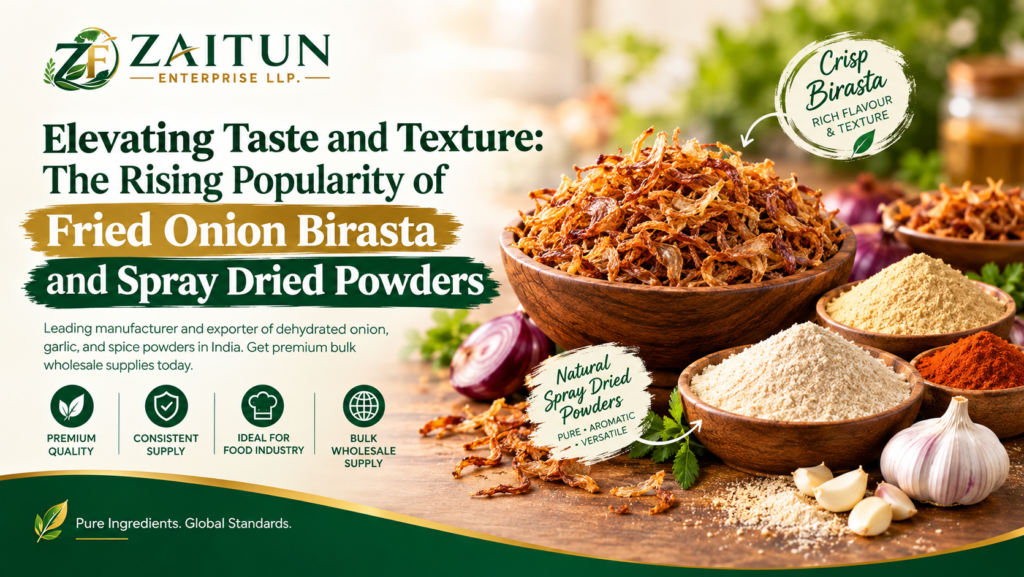
The Secret Behind Authentic Taste: Crispy Fried Onion Birasta
Fried onion birasta is the golden, slow-caramelized soul of South Asian, Middle Eastern, and Persian cuisines. Replicating this deep, savory profile in high-capacity food processing requires extreme operational precision. In-house manual frying creates uneven batches, wastes thousands of liters of cooking oil, and introduces free fatty acids that shorten retail shelf life.
Partnering with an audited Fried Onion Birasta Supplier removes these culinary bottlenecks. Commercial production facilities use continuous, indirect-heat fryers equipped with automatic oil filtration and centrifugal de-oiling systems to achieve uniform caramelization across metric-ton volumes.
The resulting crispy fried allium delivers several operational benefits for commercial processors:
- Sustained Structural Crunch: Centrifugal de-oiling removes excess surface oil, keeping flakes crispy inside retort pouches, dry meal kits, and burger toppings.
- Low Water Activity: Water activity values stay below 0.35 aw, preventing bacterial growth and protecting the texture of accompanying dry meal components.
- Immediate Labor Savings: Your factory floor eliminates manual peeling, tears from sulfur vapors, dirty oil disposal, and open-pot fire hazards.
Formulators rely on diverse raw cut profiles depending on the specific manufacturing line. When preparing clear instant soups or stew bases that need clean rehydration without frying oil, factory heads partner with an accredited White Onion Flakes Manufacturer to keep broth clarity pristine.
For balanced savory bases in simmered sauces, plant teams source through a dedicated Pink Onion Flakes Manufacturer to incorporate natural sweetness, or integrate cuts from an established Red Onion Flakes Supplier when their product lines demand strong visual appeal and robust pungency.
Innovations in Flavor: The Role of Spray Dried Fruit & Vegetable Powders
While crispy flakes deliver bite and visual appeal, dry blending lines and extruded snack dustings require total solubility. Conventional hot-air drying can cause uneven grittiness, scorched sugars, and faded color tones.
To overcome this, R&D departments work with a specialized Spray dried fruit & vegetable powders manufacturer. Spray drying atomizes fresh fruit juice or vegetable purée into micro-droplets inside a drying chamber. Hot air flashes the water off in fractions of a second, leaving micro-encapsulated flavor spheres that dissolve instantly in cold or warm liquids.
| Functional Characteristic | Standard Air-Dried Powders | Spray Dried Fruit & Veg Powders |
| Particle Morphology | Irregular, angular fragments | Hollow spherical micro-beads |
| Cold-Water Solubility | Slow dispersion, leaves sediment | Instant complete dissolution |
| Thermal Stress Level | Extended hours of warm heat | Split-second moisture flash |
| Color & Pigment Retention | Subject to heat degradation | Preserves natural bright tones |
| Flowability in Hoppers | Prone to bridging and clumping | Free-flowing micro-granules |
Spray dried powders excel across high-volume production formats:
1. Extruded Snack Seasonings and Dusts
Snack food plants need fine flavor coatings that adhere evenly to potato chips, tortilla crisps, and corn curls without dripping or clumping inside tumbling drums. Spray dried mango, tomato, cheese, or lime powders deliver vivid color and intense flavor with zero artificial dyes.
To build authentic depth into seasoning coatings, developers combine spray dried fruit solids with micro-ground Dehydrated White Onion Powder to give savory snacks a balanced, mouthwatering finish.
2. Beverage Mixes and Instant Health Blends
Powdered sports drinks, functional botanical teas, and instant health beverages require clear solubility. Spray dried beetroot, spinach, and berry powders hydrate without chalky residue, off-odors, or sediment settling at the bottom of the bottle.
To review how post-harvest curing and raw crop quality impact active flavor extraction, read this comprehensive breakdown on raw material sourcing for dehydrated onion, garlic, and ginger.
Sourcing Challenges Solved by a Reliable Dehydrated Food Products Exporter
Managing cross-border procurement for delicate ingredients like fried birasta and spray dried powders presents complex operational hurdles. Fried items face oxidation if exposed to oxygen, while fine powders cake immediately in humid marine transit.
Working with an experienced Dehydrated food products exporter neutralizes these global supply chain vulnerabilities:
Securing ingredients through an accredited export partner protects your manufacturing lines in four vital ways:
1. Nitrogen-Flushed Barrier Packaging
To prevent fried alliums from going stale during 40-day ocean voyages, export containers are packed with nitrogen flushing inside heavy-gauge aluminum-barrier foil liners. This technique keeps oxygen levels below 1%, protecting delicate oils from oxidation until your operators open the seal.
2. Strict Mesh and Density Specifications
Industrial packaging machines rely on predictable bulk density. Reputable onion powder manufacturers and ingredient processors verify particle sizing via mechanical vibrating sieves, ensuring dry ingredients flow smoothly through auger fillers without jamming.
3. Streamlined Multi-Ingredient Logistics
Global procurement teams run into logistical headaches when juggling six different suppliers for one formulation. Partnering with a comprehensive supplier allows you to consolidate multiple functional products into a single shipping manifest:
- Clean base seasonings through a certified Dehydrated garlic powder manufacturer
- High-volume allium cuts via an experienced Dehydrated onion supplier
- Pungent base notes with standardized dry garlic powder
- Fine water-soluble blends from a specialized dehydrated vegetable powder maker
- Complete pallet loads of Dehydrated vegetables bulk lines
Procuring your bulk supply from a verified Dehydrated vegetables manufacturer simplifies vendor auditing, lowers clearing charges at destination ports, and eliminates container demurrage costs.
For detailed guidelines on tariff classifications, phytosanitary certificates, and calculating landed freight costs, study this practical b2b sourcing guide for dehydrated vegetables.
Integrating certified onion powder suppliers and verified vegetable processors guarantees that your operations avoid batch delays, out-of-spec deliveries, and retail recalls. Reliable dehydrated food products let you scale brand production smoothly across international markets.
Frequently Asked Questions
What prevents fried onion birasta from becoming rancid during international ocean freight?
Quality exporters prevent oil degradation by using high-stability cooking oils with low free fatty acids, running centrifugal de-oiling to remove excess surface fats, and sealing product in heavy-gauge barrier bags with nitrogen flushing. This limits oxygen exposure and maintains crisp freshness for 12 months.
How do spray dried fruit and vegetable powders achieve complete water solubility?
Spray drying rapidly evaporates atomized liquid droplets into micro-spherical beads. When mixed into cold or hot water, these hollow micro-beads hydrate across their entire surface area instantly, dissolving completely without requiring shear blending or boiling.
What export documentation is required for clearance in Europe and North America?
Container shipments must include a clean Certificate of Analysis (COA) specifying microbiological limits, a Phytosanitary Certificate from the exporting country, a Non-GMO declaration, heavy metal and pesticide residue test reports, and an accurate Bill of Lading matching commercial customs invoices.
Can food processors request custom particle sizes for spray dried powders?
Yes. Processors specify target mesh sizes (commonly 60 to 120 mesh) and bulk density parameters to match their blending equipment, pneumatic delivery systems, and dissolving speed requirements.
Zaitun Enterprise supplies commercial food brands, snack manufacturers, and international food distributors with certified, export-grade specialty ingredients. When your formulations demand consistent crunch, verified purity, and factory-direct container shipments, reach out to our export sales team to request technical samples and schedule a shipment.