
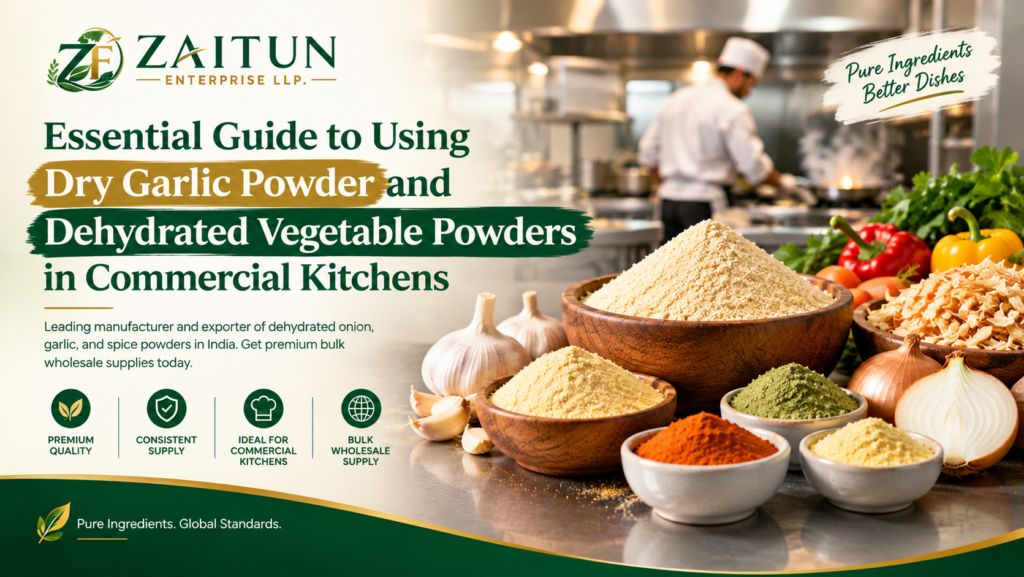
Running high-output commercial kitchens, industrial catering commissaries, or ready-to-eat sauce lines requires absolute recipe consistency. When your cooking staff prepares thousands of liters of marinara, dry rubs for rotisserie lines, or savory pie fillings across multiple daily shifts, measuring raw cloves and wet roots introduces chaos into batch chemistry.
Raw garlic brings inconsistent pungency depending on crop maturity, while raw vegetables leak uncontrolled water into reduction pans. These variables cause texture separation, inconsistent cook-down times, and batch-to-batch taste discrepancies.
Commercial culinary directors solve this challenge by integrating stable dehydrated vegetables and concentrated allium powders into standard operating procedures. Working with a dedicated Dehydrated Onion Manufacturer enables industrial kitchens to achieve repeatable flavor, speed up hopper loading, and maintain strict nutritional accuracy across every production facility.
The Convenience of Spice Powders in Mass Food Production
High-volume food production runs on precision timing and labor efficiency. Peeling, washing, chopping, and puréeing raw alliums consumes hundreds of labor hours every month, while generating substantial wet vegetable waste that drives up facility disposal fees.
Powdered and flaked ingredients drop directly into industrial steam kettles, horizontal ribbon blenders, and pneumatic seasoning depositors with zero preparation time.
| Operational Challenge | Fresh Allium & Vegetable Prep | Commercial Powders & Dried Flakes |
| Active Prep Labor | High: peeling, mincing, sanitizing | Zero: ready for direct hopper dosing |
| Water Content Added | High (80% to 90% water by weight) | Minimal (< 5% moisture content) |
| Dispersal in Dry Mixes | Impossible without baking off water | Instant, uniform distribution |
| Cold Storage Demand | Heavy refrigeration footprint | Ambient dry storage on pallets |
| Microbial Vulnerability | High surface spore count | Low TPC, pathogen-tested batches |
Texture planning determines which particle cut matches your cooking method. When simmering hearty broths or chunky noodle bowls, chefs source diced cuts from a certified White Onion Flakes Manufacturer to build vegetable body without peeling bulbs.
For simmered curries and regional culinary sauces, production leads often source through a verified Pink Onion Flakes Manufacturer to impart sweetness or order from a trusted Red Onion Flakes Supplier to achieve deep color accents and lingering pungency.
For automated dry coating lines, extruded snack dusting, and smooth emulsions, nothing matches the immediate solubility of dehydrated vegetable powder. Fine meshes dissolve into oil slurries and water bases without separating or clogging spray nozzles.
Blending Dry Garlic Powder with Dehydrated Vegetable Powders for Unique Profiles
Balancing allium bite against earthier vegetable tones is the foundation of savory recipe design. When formulating signature spice rubs, dry batter blends, or instant soup bases, dry garlic powder serves as an aromatic backbone that elevates umami perception across the entire palate.
Formulators combine micro-milled Dehydrated White Onion Powder with sharp alliums to construct shelf-stable seasoning blends that disperse evenly without clumping.
Key industrial blending ratios to optimize flavor and texture:
1. Dry Poultry and Barbecue Rubs
- 40% Coarse Sea Salt and Cracked Black Pepper
- 25% Dry Garlic Powder (40 to 60 mesh for surface adhesion)
- 20% Onion Powder
- 15% Paprika and Dehydrated Tomato Powder
This formulation adheres tightly to chilled meats, caramelizing during roasting without scorching, unlike raw garlic which chars and turns bitter over direct flames.
2. Instant Cream Soup Bases
- 50% Modified Food Starch and Dairy Solids
- 20% Dehydrated vegetable powder (Mushroom, Celery, or Carrot)
- 15% Fine Onion Powder (80 to 100 mesh)
- 15% Garlic Powder and White Pepper
Fine powder blends hydrate smoothly in hot liquids within 90 seconds, creating rich gravies and creamy bisques without lumping.
3. Savory Snack Dusts and Extruded Coatings
Snack makers source specialized ingredients through a Dehydrated garlic powder manufacturer that provides custom oil-soluble grinds. Blending this with fine dried alliums creates seasonings that cling to potato crisps and extruded corn puffs.
Adding rich garnishes from an authentic Fried Onion Birasta Supplier delivers visual appeal and authentic toasted crunch to prepared rice kits and ready-to-eat biryanis.
For detailed recommendations on raw material quality and moisture parameters, check out this deep dive on raw material sourcing for dehydrated onion, garlic, and ginger.
Storage and Handling Tips to Prevent Clumping
Because culinary powders contain less than 5% water, they are naturally hygroscopic. When exposed to ambient kitchen steam, unsealed bags pull moisture from the air, causing particles to fuse into solid bricks.
1. Dual-Barrier Packaging Protocol
Never leave open bags exposed on kitchen prep tables. After scooping your required batch weight, evacuate excess air from the poly-liner, twist and secure it with an airtight clamp, and close the outer corrugated carton.
2. Temperature and Relative Humidity Controls
Maintain dry ingredient storage zones between 18°C and 22°C with relative humidity below 60%. Elevate boxes on wooden or plastic pallets to stop moisture migration through concrete slabs.
3. Batch Staging Discipline
Transfer only the exact weight needed for a specific production run to the blending room. Introducing bulk containers into warm, steam-filled kitchen zones creates condensation inside the packaging.
Supply chain managers frequently review this b2b sourcing guide for dehydrated vegetables to calculate shipment schedules, container loading capacities, and warehouse shelf life turnover.
By purchasing dehydrated vegetables bulk shipments directly through an established Dehydrated food products exporter, operations ensure uniform packaging integrity across large volumes.
Whether your production floor sources through specialized onion powder manufacturers, contracts bulk lots from an accredited Dehydrated vegetables manufacturer, or works with a Spray dried fruit & vegetable powders manufacturer for topical seasoning applications, verifying batch-level sealing prevents inventory loss.
Working with an audited Dehydrated onion supplier or trusted onion powder suppliers ensures that all incoming shipments of dehydrated food products meet consistent microbiological standards and safe packaging guidelines.
Reliable dehydrated vegetables form the operational backbone of modern, high-speed food assembly lines, cutting prep hours while keeping batch flavors identical day after day.
Frequently Asked Questions
What is the typical replacement ratio when substituting dry garlic powder for fresh cloves?
Use 1/8 teaspoon of pure dry garlic powder to replace one medium clove of fresh garlic. For industrial production, 1 kilogram of high-pungency powder replaces roughly 5 to 6 kilograms of raw, peeled garlic cloves by sensory strength.
How should commercial kitchens store bulk bags after opening?
Transfer remaining powder into food-grade, airtight drums fitted with rubber gasket seals, or tightly clamp the inner polyethylene bag inside its export carton. Store in a dedicated dry-goods room kept below 22°C and away from steam lines.
What causes vegetable powders to cake, and can caked powder be rescued?
Caking happens when hygroscopic dry powders absorb atmospheric water vapor, dissolving surface sugars and welding particles together. If the powder has only formed soft lumps without off-odors, running it through a sanitary mechanical sifter restores flowability. If hard blocks form, discarding the batch is best to maintain recipe accuracy.
What shelf life can industrial kitchens expect from properly sealed vegetable powders?
Under ambient conditions with low humidity, unopened export-grade powders retain full volatile strength and flowability for 18 to 24 months from the manufacturing date.
At Zaitun Enterprise, we supply global food brands, commercial commissaries, and spice packers with laboratory-tested allium powders and dried culinary components. If your production lines require consistent raw materials, contact our ingredient specialists to order testing samples and secure wholesale container pricing.