
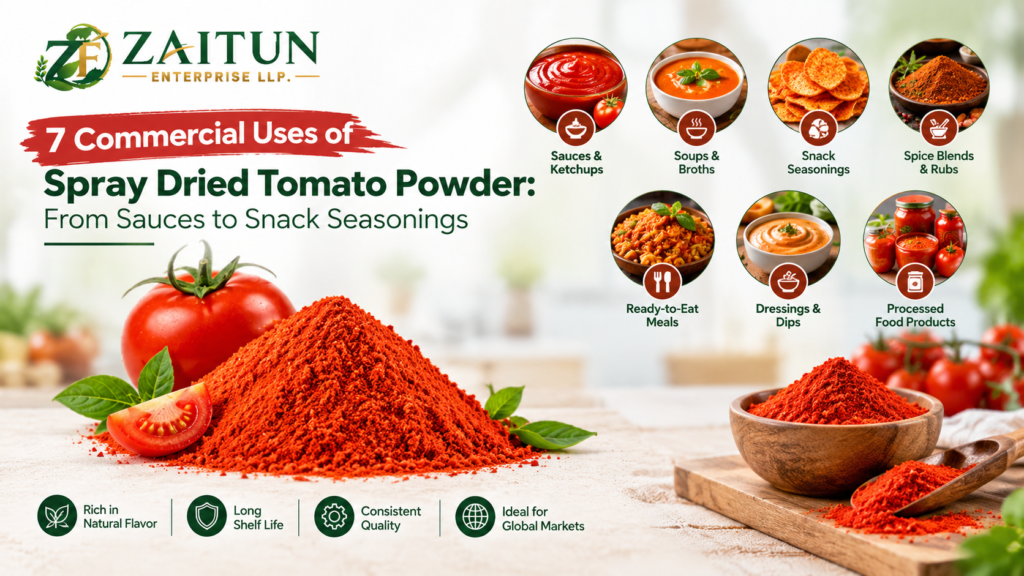
For food processors working at scale, fresh tomatoes are a logistics headache. Prices swing wildly across seasons, pulp quality varies from one supplier to the next, and shelf life rarely survives long transport routes. Spray drying solves all three issues in a single step: it concentrates the pulp into a free-flowing red powder that behaves predictably in every batch, from a ketchup line in Nashik to a seasoning plant in Rajkot.
This guide walks through seven real-world applications where spray dried tomato powder has replaced tomato paste, puree, or diced product entirely. Each section looks at how the powder behaves in the formulation, what dosage range works, and what buyers should check before committing to a vendor. If you run a sauce bottling unit, a snack brand, or a masala export house, there is likely a cost line here worth revisiting.
What Makes Spray Dried Tomato Powder Different
Spray drying is a controlled dehydration process where tomato pulp is atomised into fine droplets inside a hot-air chamber. The water evaporates in seconds, leaving behind a free-flowing powder with 3 to 5 percent residual moisture and 95 percent of the original flavour locked in. Unlike drum-dried or sun-dried alternatives, spray dried tomato powder retains its lycopene content, natural red colour, and umami depth almost in full.
The texture is uniform. The reconstitution is quick. One kilogram of powder equals roughly 6 to 7 kilograms of fresh tomato pulp. For a Commercial spray dried powder manufacturer running at scale, this concentration ratio translates directly into lower warehouse costs, lighter freight bills, and faster line changeovers.
1. Ready-to-Eat Sauces and Ketchup Bases
Ketchup manufacturers were among the first to adopt tomato powder in India. The reason is straightforward: fresh tomato puree carries 85 to 88 percent water, which means paying freight for water you later evaporate during cooking. Dehydrated food products like tomato powder cut that cost by delivering concentrated solids ready for direct hydration in the mixing tank.
Typical dosage ranges from 8 to 14 percent of the finished batch, depending on whether the end product is a thin table sauce or a thick cocktail-grade ketchup. The powder blends cleanly with vinegar, salt, sugar, and starch systems. For co-packers running multiple SKUs on one line, switching between brands becomes a matter of adjusting dosage, not swapping entire pulp tanks.
2. Instant Soup and Noodle Seasoning Sachets
Sachets inside noodle packs and cup-soup lids are tight real estate. Every gram of powder has to deliver maximum flavour impact after rehydration with boiling water. Tomato powder works here because it disperses in under 30 seconds and releases colour instantly, which is critical for the visual appeal of the bowl.
Brands making tomato-flavoured ramen, cream of tomato soup, or minestrone bases typically combine the powder with onion powder, dry garlic powder, and a Dehydrated green chilli powder note for warmth. A dehydrated vegetables manufacturer supplying this segment usually keeps a 100-mesh grade in stock so the sachet contents stay free-flowing even in humid monsoon packaging conditions.
3. Snack Coatings and Namkeen Seasonings
The Indian snack market, worth over 42,000 crore and growing at 11 percent CAGR, runs on tangy coatings. Tomato-flavoured chips, extruded puffs, cornitos, bhujia, and savoury twists all rely on dry seasoning powders tumbled onto a hot or oiled base. Spray dried tomato powder gives that familiar tangy-sweet note along with the deep red colour consumers expect from the pack.
Finished seasoning blends like tomato magic seasoning combine the powder with salt, sugar, acidulants, and dairy solids for a ready-to-apply topping. For brands running private-label snack SKUs or QSR french-fry seasonings, buying a pre-blended coating from a dehydrated vegetable powder suppliers partner is faster and more consistent than mixing it in-house.
4. Pasta Sauces, Pizza Mixes, and Italian Blends
QSR chains and HORECA suppliers running pasta or pizza menus rarely cook sauce from scratch. The economics do not work above a certain daily cover count. Instead, they rely on dry sauce mixes that reconstitute with hot water or oil, delivering the same marinara, arrabbiata, or napolitana profile across every outlet.
Tomato powder forms the backbone of these mixes at 35 to 50 percent of the dry weight, combined with herbs, cheese powder, garlic, and salt. For buyers wanting a ready blend, tomato masala powder is a popular option used in both ready-to-eat gravy pouches and HORECA sauce bases. The powder format also solves cold-chain gaps that fresh pulp cannot handle on long dispatch routes.
5. Dry Seasoning Blends and Masala Mixes
Indian spice houses have shifted much of their standard masala production to pre-blended, shelf-stable formats. Chicken curry masala, paneer tikka masala, kadhai mix, and biryani blends all now feature tomato powder as a ready-made souring and colouring agent. It removes the need for a separate wet tomato step in the end kitchen.
A tangy variant like tomato tangi masala suits chaat applications, dahi puri toppings, and dry snack coatings where consumers want a sharp sweet-sour kick. Food plants that already stock dehydrated vegetable powder lines, including dry garlic powder and onion powder, often consolidate tomato powder with the same vendor to simplify procurement and keep COA documentation under one roof.
6. Bakery and Savoury Cracker Toppings
Savoury biscuits, crackers, breadsticks, and focaccia-style flatbreads use tomato powder in two ways: dusted on the surface as a visible topping, or kneaded into the dough as a flavour and colour modifier. Fresh tomato pulp cannot be used in dough because its moisture ruins the gluten structure and bakery shelf life.
At 1 to 3 percent of dough weight, tomato powder gives the finished biscuit a rust-red tint and a mild umami that pairs well with oregano, basil, and chilli flakes. Bakery export units shipping to the Gulf and Southeast Asia prefer powder over paste because it eliminates refrigeration during transit and keeps the loaded container at ambient temperature all the way to the port.
7. Nutritional and Functional Food Formulations
Tomato powder is one of the richest natural sources of lycopene, a carotenoid linked to cardiovascular and prostate health in multiple clinical reviews. Nutraceutical brands building functional powders, meal-replacement shakes, savoury protein mixes, and lycopene-fortified capsules buy spray dried tomato powder as the active base.
The spray-drying process is gentler on heat-sensitive compounds than drum drying, which is why Spray dried fruit & vegetable powders manufacturer facilities equipped with inlet temperatures below 180 degree Celsius retain more of the bioactive content. Buyers in this segment demand full COAs covering lycopene content (expressed in mg per 100 g), heavy metals, aflatoxins, and pesticide residues, so vendor selection matters more than price alone.
For the full catalog of related powders used in these formulations, our spray dried range covers tomato, lemon, tamarind, pineapple, mango, and cheese profiles in one place.
Why Spray Drying Beats Other Preservation Methods
Tomato can be preserved in several ways: canned paste, aseptic puree, frozen dice, drum-dried flakes, or spray dried powder. Each has a cost and a quality curve. Here is a quick comparison that most procurement teams run before switching formats:
- Canned paste: Lowest raw material cost per kg of solids, but high freight (85 percent water), tin cost, and short post-opening life.
- Aseptic puree in drums: Common for ketchup lines, but needs cold storage and has 6 to 9 month shelf life.
- Drum-dried flakes: Cheaper per kg than spray-dried, but darker colour, caramelised notes, and poor cold-water dispersion.
- Spray dried powder: Best colour retention, cleanest flavour, 18 to 24 month shelf life, free-flowing texture, zero cold chain.
The trend in the Indian processed food industry is clearly toward spray-dried formats. This rising trend of spray dried powders is being driven by snack brands, QSR expansion, and the export market demanding ambient-stable ingredients.
In the broader category of dehydrated food products manufacturers, spray drying is now the preferred technology for anything pulpy or juice-based, including fruit powders, dairy powders, and vegetable concentrates. The capex is heavier than drum drying, but the quality lift justifies the premium for most branded applications.
Picking the Right Spray Dried Tomato Powder Supplier
Switching formats is easy. Sticking with a reliable vendor across years of production is harder. Based on what works for most mid-to-large food manufacturing units, these are the vendor filters that actually matter:
- Varietal clarity: Which tomato cultivar (Roma, San Marzano hybrids, Indian processing types)? This drives colour and brix.
- Drying inlet temperature: Below 180 degree Celsius preserves lycopene and flavour volatiles.
- Mesh grade options: 60, 80, 100, and 150 mesh for different end uses.
- Microbiological COAs: Total plate count under 10,000 CFU/g, yeast and mould under 100 CFU/g.
- Certifications: FSSAI, FSSC 22000, HALAL, KOSHER, and organic (NPOP, NOP, EU) where relevant.
- Minimum order flexibility: From 100 kg trial lots to 10-ton container shipments.
- Allied range: A vendor who also handles dehydrated onion, dry garlic powder, Dehydrated green chilli powder, and fried onion birasta saves you from juggling multiple purchase orders.
A Food ingredients manufacturer India buyers trust will have shipping references to the EU, Gulf, USA, and ASEAN markets, plus the paperwork templates ready for each destination. If your product line will scale toward Dehydrated Foods & Spices Exporter status, having an established partner from day one shortens the learning curve on documentation and compliance.
Buyers already working with a Dehydrated Vegetables & Food Products Manufacturer for their onion and garlic supply often extend the contract to include tomato powder, since the same quality and certification standards apply across the catalog. For buyers wanting dehydrated foods bundled with spray-dried fruit solids, consolidation also unlocks better freight pricing on export containers.
Frequently Asked Questions
Q1. How much spray dried tomato powder equals 1 kg of tomato paste?
Roughly 150 to 180 grams of powder reconstituted with 850 ml of water matches the solids content of 1 kg of 28 brix tomato paste. Final texture depends on the end formulation.
Q2. Does spray dried tomato powder retain lycopene?
Yes. When drying inlet temperatures are kept below 180 degree Celsius, 80 to 90 percent of the original lycopene survives. Protection from light and oxygen during storage keeps it stable for the full shelf life.
Q3. What is the typical shelf life of the powder?
18 to 24 months in sealed, laminated packaging stored at ambient temperature below 30 degree Celsius. Once opened, use within 3 to 6 months and keep in airtight containers away from humidity.
Q4. Can it be used in cold applications like smoothies or dressings?
Yes, provided the particle size is 100 mesh or finer. For salad dressings, pre-hydrate the powder in a little oil or vinegar for better dispersion.
Q5. Is there an organic variant available?
Some dehydrated vegetables manufacturers offer organic dehydrated foods including NPOP or NOP-certified tomato powder. Confirm the scope certificate matches your export market before ordering.
Q6. What is the minimum order quantity?
Most B2B dehydrated food products exporter vendors accept trial orders from 100 kg, with regular contracts starting at 500 kg per month. Volume pricing usually kicks in above 2 tons.
Q7. How does it compare with tomato paste on cost per batch?
After adjusting for water content, freight, cold storage, and shelf life waste, spray-dried powder usually works out 10 to 20 percent cheaper per finished batch for most sauce and seasoning applications.
Ready to Reformulate with Spray Dried Tomato Powder?
If your current recipe still runs on tomato paste or wet puree, a trial batch with spray dried tomato powder could lighten freight bills, free up cold storage, and tighten your flavour consistency within a single quarter. For specification sheets, mesh grade options, and sample dispatch across all seven use cases above, contact us for bulk inquiry and the sourcing team at Zaitun Enterprise will respond with the right fit for your production profile.
For buyers already running onion, garlic, chilli, or birasta on their line, consolidating tomato powder with the same Dehydrated Onion Manufacturer and dehydrated vegetable powder manufacturers partner also simplifies audit paperwork and freight consolidation.