
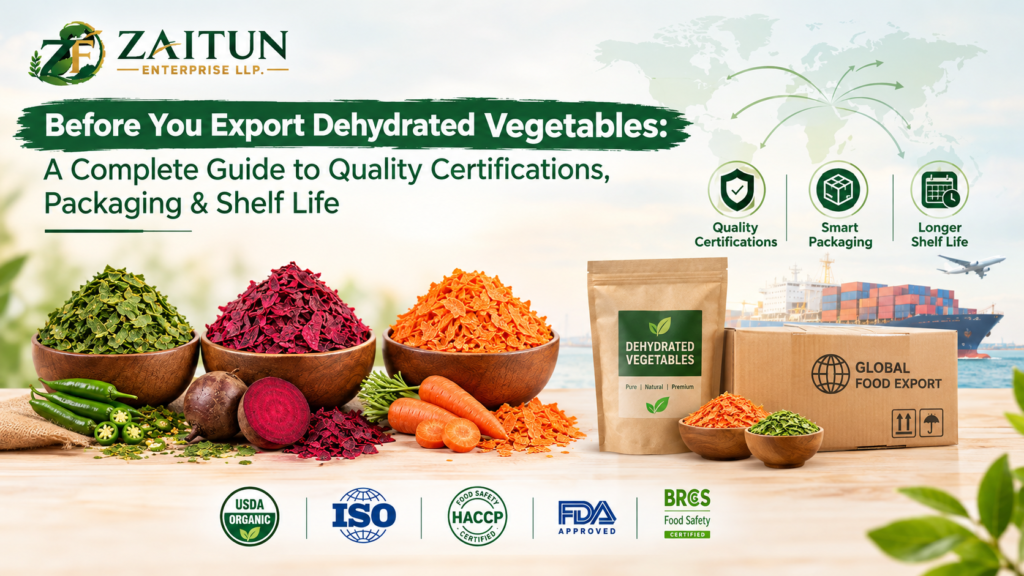
Exporting dehydrated vegetables sounds straightforward until the first container clears Mundra or Nhava Sheva and lands at a port where the buyer rejects it over a missing phytosanitary line or a moisture reading that is 0.4 percent too high. For every successful first shipment, there are three that get stuck in cold storage at the port of entry while paperwork is sorted out.
This guide covers what any new or scaling Dehydrated food products exporter needs to have in place before quoting an international buyer. It walks through certifications that are non-negotiable, packaging formats that survive 45-day ocean transits, shelf life science that keeps COAs valid, and the paper trail that gets your container cleared at the destination port without a demurrage bill. If you are planning your first export cycle or trying to understand why a repeat buyer went silent after one shipment, the answers are usually in one of these sections.
Why Export Readiness Matters More Than Price
India is the world’s second-largest producer of dehydrated vegetables, with Gujarat alone supplying over 70 percent of national onion dehydration capacity. The raw material edge is real. The exporter edge is not automatic. Buyers in the EU, GCC, USA, and ASEAN are not comparing you only on FOB price. They are comparing you on batch consistency, documentation quality, response time to COA queries, and the ability to repeat the same spec six months later without excuses.
A single rejected shipment at a destination port can cost more than the first ten profitable ones combined, once you add demurrage, re-export freight, and the lost buyer relationship. For a serious Dehydrated vegetables manufacturer, the question is not whether to invest in certifications and packaging rigour; it is how fast to get them in place before the first large contract. The business case for export readiness is as much about defence as it is about growth.
For a deeper read on how to think about commercial sourcing before any export shipment, this piece on B2B sourcing guide for dehydrated vegetables covers vendor evaluation frameworks that apply equally to import buyers evaluating you.
Essential Quality Certifications for Dehydrated Vegetable Exports
Not every certification is mandatory everywhere, but a core stack is what buyers now expect before even opening a sample conversation. Here is how they stack up by purpose.
FSSAI (Mandatory in India)
Every dehydrated food products exporter operating out of India needs a valid FSSAI Central license, not a state license, since exports fall under central jurisdiction. The license number appears on every carton, every COA, and every commercial invoice. Buyers in regulated markets routinely verify the license on the FSSAI portal before releasing payment on the first container.
FSSC 22000, ISO 22000, and HACCP
These are the three food safety management standards most import buyers ask for. FSSC 22000 is now the preferred benchmark across EU and Walmart-tier retail buyers. ISO 22000 is acceptable for most Gulf and ASEAN markets. HACCP is the baseline that even smaller buyers in Southeast Asia expect to see. A facility certified under FSSC 22000 usually clears audits for the other two without additional work.
HALAL and KOSHER
For shipments to the GCC, Malaysia, Indonesia, and Turkey, HALAL certification from a recognised body (JAKIM-accredited for Southeast Asia, Jamiat Ulama-i-Hind for the GCC) is non-negotiable. KOSHER opens up Israeli buyers and a significant chunk of US specialty food importers. Both certifications cover not only the product but also the facility, equipment, and cleaning agents, so renewal cycles need to be tracked carefully.
Organic Certifications (NPOP, NOP, EU Organic)
For organic dehydrated foods, each export destination requires its own certification scope. NPOP covers India and bilateral equivalence markets. NOP is for the USA. EU Organic covers the European Union. A single facility can hold all three, but the scope certificates have to list the specific product (dehydrated onion flakes, Dehydrated green chilli powder, tomato powder, and so on) that is being exported under that standard.
Country-Specific Requirements
USA buyers may ask for FDA registration and FSVP compliance. EU buyers require EU hygiene compliance, allergen declarations, and sometimes IFS or BRCGS certification depending on retailer. Australia expects BICON import permits. Japan has its own JAS organic standard. A well-prepared Dehydrated food products exporter maintains a certification matrix mapped to buyer countries and renewal dates, not a shoebox of expiring PDFs.
Packaging Standards for International Shipments
Packaging decides whether your product arrives at the port in sellable condition or as a claim. The three variables that matter most are moisture barrier, light barrier, and crush resistance during ocean transit.
Primary packaging for most dehydrated vegetables bulk shipments uses food-grade LDPE or metallised PET liners inside kraft paper or HDPE woven bags. Standard pack sizes are 10 kg, 20 kg, and 25 kg. For buyers running automated filling lines, 500 kg to 1-ton jumbo bags (FIBC with inner liner) reduce handling costs at their end.
Secondary packaging should carry the lot number, manufacturing date, best-before date, FSSAI number, net weight, country of origin, and the buyer’s SKU barcode if provided. Printing should be in food-grade ink that will not transfer to the primary pack.
Tertiary packaging means container loading plan. A 20-foot container typically holds 10 to 12 tons of dehydrated vegetable powder on pallets, with silica gel sachets placed every 500 kg to control condensation during temperature swings between the equator and higher latitudes. Dehydrated flakes with lower bulk density may fill cube before weight. For a Dehydrated vegetable powder & flakes supplier shipping to the Middle East or EU, specifying a ventilated or dehumidified container avoids most moisture pickup issues.
Across dehydrated foods, the general rule is: never ship a product in a pack that cannot survive 55 degree Celsius for 48 hours, because that is the thermal reality inside a container crossing the Red Sea in July. If you work across multiple SKUs, standardising packaging formats across your dehydrated flakes range saves on tooling and simplifies warehouse logistics.
Shelf Life, Moisture, and Microbial Control
Shelf life claims on your COA are a legal commitment, not marketing text. For most dehydrated food products the standard is 18 to 24 months when stored at ambient temperature below 30 degree Celsius and relative humidity under 60 percent.
The three parameters that make or break this claim:
- Residual moisture: Below 6 percent for powders, below 8 percent for flakes. Higher moisture triggers microbial growth within weeks.
- Water activity (Aw): Below 0.6 is the safety threshold. Above 0.65 and yeast or mould can proliferate even in a sealed pack.
- Microbial load: Total plate count under 10,000 CFU/g, yeast and mould under 100 CFU/g, E. coli absent in 25 g, Salmonella absent in 25 g.
Steam sterilisation is now the preferred decontamination method since ETO is restricted or banned in multiple markets. For buyers of Export Quality Dehydrated Food Products, insisting on steam-treated inputs is standard. The slight premium is recovered in the first avoided rejection.
Accelerated shelf life testing (ASLT) at 40 degree Celsius for 90 days is a reasonable proxy for 18-month ambient storage. A Dehydrated vegetables manufacturers lab that can run ASLT in-house gives you faster confidence when launching a new SKU for an export buyer. For buyers specifying strict moisture limits across the dehydrated powder range, insist on moisture testing per batch rather than per production week.
Documentation Checklist for Export
Missing documents are the single most common reason first-time exporters miss delivery dates. Before the container leaves the plant, every shipment should carry a complete file ready to send to the buyer and the destination customs broker:
- Commercial Invoice with HS code, incoterm, and total value.
- Packing List matching the invoice line by line.
- Bill of Lading (ocean) or Air Waybill (air).
- Certificate of Origin (preferential or non-preferential depending on FTA eligibility).
- Phytosanitary Certificate issued by the Plant Quarantine authority.
- Certificate of Analysis (COA) per lot with microbial, moisture, and heavy metal results.
- Health Certificate for destinations that require it (common for GCC and parts of Asia).
- HALAL / KOSHER / Organic certificates matching the SKUs on the invoice.
- Fumigation Certificate if wooden pallets or specific packaging materials are used.
- Declaration of Non-GMO / Allergen Statement where buyer or destination asks for it.
For repeat buyers, keeping a shared Dropbox or SharePoint folder with the latest version of each certificate avoids last-minute scrambles. A seasoned Dehydrated Foods & Spices Exporter will also keep bilingual translations ready for Arabic, French, and Spanish destination markets. If you want a reference on how buyers themselves think about documentation when sourcing, B2B sourcing for exports explains the view from the import side.
Common Rejection Reasons at Port of Entry
Understanding why containers get rejected is cheaper than experiencing it. These are the recurring reasons across EU, GCC, USA, and ASEAN rejection logs:
- Moisture above 7 percent on arrival testing (usually a packaging failure or long warehouse hold before shipment).
- Pesticide residue above MRL for the destination country (MRLs vary country to country, and India’s limits are usually looser than the EU’s).
- ETO or chloropropanol residue in steam-sterilised products that were actually ETO-treated earlier in the supply chain.
- Aflatoxin above 10 ppb for spices and chilli-containing blends.
- Mislabelled lot number that does not match the COA submitted.
- Pest infestation (live or dead insects, usually from inadequate pre-shipment fumigation).
- Missing or mismatched phytosanitary certificate.
- Country of origin not marked on primary packaging.
For a Bulk Dehydrated Spices Supplier Worldwide, running pre-shipment third-party lab testing per lot is standard practice. The cost of a 15,000 rupee lab test is trivial next to the 15 lakh rupee cost of a rejected container returning to port. For dehydrated vegetable powder suppliers running export volumes, keeping a reference sample of every lot for 24 months lets you reconstruct the chain of custody if any claim comes up later.
Picking an Export-Ready Supplier (or Becoming One)
If you are a buyer sourcing from Indian suppliers, or a trader building your export vendor base, the filter list below separates export-ready vendors from those still in the domestic learning curve:
- Export history: Ask for the last five bill of lading numbers and destination countries, not just a client logo wall.
- In-house lab: Vendors with internal moisture, Aw, and microbial testing can give same-day COAs. Those relying only on external labs run 5 to 10 day delays per batch.
- Pack-size flexibility: From 25 kg bags to 1-ton FIBCs under the same quality spec.
- Allied dehydrated products: A vendor who also handles dehydrated onion flakes, dry garlic powder, Dehydrated green chilli powder, and spray-dried fruit powders consolidates your container economics.
- Communication responsiveness: First COA request answered within 24 hours is a baseline, not a courtesy.
- Documentation templates ready for your destination. EU, GCC, USA, and ASEAN each have specific formats.
- Steam sterilisation capacity for microbiologically sensitive buyers.
For exporters sourcing bulk inputs from a Dehydrated vegetables manufacturer in Gujarat, co-locating with the port of shipment (Mundra, Pipavav, or Nhava Sheva) also cuts internal freight by 20 to 30 percent on every container.
The deeper read on what separates reliable Indian producers is covered in quality standards for dehydrated food ingredients, which goes into testing parameters and batch control. For buyers evaluating a specific producer, our about Zaitun Enterprise section outlines facility scope, certifications, and operating standards used across the catalog. Those planning multi-SKU container shipments can also review our quality certifications to understand the baseline we hold across every lot.
Frequently Asked Questions
Q1. What is the single most important certification for exporting dehydrated vegetables?
FSSAI Central license is the mandatory baseline for any India-origin export. Beyond that, FSSC 22000 is the most widely accepted food safety certification by major import buyers in the EU, USA, and GCC.
Q2. How long does it take to get FSSC 22000 certified?
Typically 6 to 12 months for a facility already running food-grade processes. Expect a gap analysis, system documentation, staff training, internal audits, and the two-stage certification audit before the certificate is issued.
Q3. What packaging works best for Middle East exports?
LDPE-lined kraft or HDPE woven bags inside corrugated master cartons, loaded into a container with silica gel sachets. Avoid wooden pallets without ISPM-15 fumigation stamps.
Q4. Can dehydrated vegetables be exported without a phytosanitary certificate?
No. Any plant-based food export requires a phytosanitary certificate from the Plant Quarantine authority at the port of shipment. The destination country’s customs will not clear the container without it.
Q5. How often should COAs be issued?
One COA per production lot, not per shipment. If a shipment contains multiple lots, each lot number on the invoice must have its own COA attached.
Q6. What is the shelf life claim buyers typically accept?
18 months is the market standard. 24 months is acceptable for powders in laminated packaging with proven ASLT data. Claims above 24 months need stronger stability evidence.
Q7. Is ETO sterilisation still acceptable in international markets?
ETO is restricted or banned in the EU, UK, and increasingly in Canada and Australia. For export-grade shipments, steam sterilisation is now the standard. For a Food ingredients manufacturer India serving multiple regions, moving to steam is the safer long-term call.
Ready to Plan Your Next Export Shipment?
Getting the first container right matters more than getting the biggest first order. If you are building an export line of dehydrated onion flakes, Dehydrated white and red onion flakes export SKUs, dehydrated vegetable powder manufacturers blends, or spray-dried fruit solids, start with specification sheets, certification scope, and sample dispatch before the price negotiation.
For COA samples, pack-size options, container loading plans, and buyer-country documentation templates, contact us for bulk inquiry and the sourcing team at Zaitun Enterprise will respond within one working day. For buyers extending their basket to Fried Onion Birasta Supplier SKUs, Dehydrated garlic powder manufacturer references, or a full Dehydrated Vegetables & Food Products Manufacturer catalogue, bundling the inquiry upfront saves back-and-forth.